Naming service classes in Rails

Programming·Ruby Rails

One of the core ideas of Rails is convention over configurations. Models go in app/models, controllers go in app/controllers and views go in app/views. The danger is that we stick to those conventions no matter what and we end up either with fat controllers, fat models or even worse a mixture of both.

Many times we don’t take enough advantage of Ruby’s object oriented nature and the ability to extract functionality out into separate classes. Doing so can make an entire application easier to extend, understand and test. I have tried approaching this from different angles in different projects and I’ve found that the two main hurdles to getting this right are naming classes and putting them in the right place.

I have experimented with naming such as UserAuthenticator and UserAuthenticationService, and always end up feeling uncomfortable I constantly wonder if the other name is better or if there is a better way entirely. Using agent nouns in class names is considered a code smell, but the more that I think about it the important part is picking a choice and sticking to it. I was looking at the GitLab repository and noticed that they’ve done exactly that, everything is named in a consistent manner. I think many may dislike that but it makes things extremely clear and easier for anyone contributing as to what they should name their classes and where they should put them.

Using blocks in Ruby for lazy evaluation

Programming·Ruby

I’ve been working on a templating engine recently and had the need to substitute some variables on the page with the result of an slightly expensive remote API call. The first iteration was just a simple replace on the page:


render_placeholder result, 
    "some_page_var", 
    ApiWrapper.some_expensive_call

def render_placeholder result, name, value
  result.gsub! name, value
end

This “worked” but the problem is the call would be made even if the variable that needed replacing wasn’t on the page. The easy fix is to check it exists before making the substitution:


render_placeholder(result, 
  "some_page_var", 
   ApiWrapper.some_expensive_call) if has_placeholder?(result, "some_page_var")

def has_placeholder? result, name
  !!result[name]
end

def render_placeholder result, name, value
  result.gsub! name, value
end

While this works, once you have a load of results you want to replace there ends up being a lot of duplication, and it’s easy to check the wrong variable compared to what you want to replace. One way to solve it is by passing the api call as a block to the substitution method. This way we can tidy up the code:


render_placeholder(result, "some_page_var") { ApiWrapper.some_expensive_call }

def has_placeholder? result, name
  !!result[name]
end

def render_placeholder result, name
  return "" unless has_placeholder?(result, name)
  result.gsub! name", yield
end

Law of Demeter and the delegate method

Programming·Ruby Rails

The Law of Demeter, or Principle of Least Knowledge is a fairly simple design pattern, which, simply put means that an object should only talk to it’s immediate “friends”

The law states that a method M of and object O may only invoke the methods of the following kind:

1. a method on O itself
2. any parameters passed to M
3. any objects instantiated within M
4. any direct components of O

The classic example coined by David Bock used a Paperboy (one object) delivering a paper, then extracting money from a Customer’s (another object) Wallet (and another):

 class Paperboy
    def get_payment(customer)
      self.money += customer.wallet.take_out(10)
    end
  end

In the “real world” the Paperboy would ask the customer for the money who would then take it out for them, rather then the Paperboy reaching into the customer’s back pocket and getting it for themself.

Really we want something as follows:

  class Paperboy
    def get_payment(customer)
      self.money += customer.get_payment(10)
    end
  end

  class Customer
    def get_payment(amount)
      wallet.take_out(10)
    end
  end

This may all seem trivial and a waste of time, but what happens if some Customers want to pay by cheque? Those decisions should have an impact on the Paperboy, otherwise we end up with:

 class Paperboy
    def get_payment(customer)
      if customer.pay_by_cash?
        self.money += customer.wallet.take_out(10)
      elsif customer.pay_by_cheque?
        self.money += customer.cheque_book.write_cheque(10)
      end
    end
  end

Where as it makes more sense for the change to be contained within the Customer:

class Paperboy
    def get_payment(customer)
      self.money += customer.get_payment(10)
    end
  end

  class Customer
    def get_payment(amount)
      if pay_by_cash?
        wallet.take_out(10)
      elsif pay_by_cheque?
        cheque_book.write_cheque(10)
      end
    end
  end

So what does this have to do with Rails and the delegate method? The delegate method adds a quick and simple way of following the Law of Demeter without having to do very much at all.

  class Order
    belongs_to :customer
  end

  class Customer
    has_many :orders
    has_one :credit_card
    has_one :bank_account

    def payment_method
      if pay_by_card?
        credit_card
      elsif pay_by_account?
        bank_account
      end
    end
  end

  class CreditCard
    belongs_to :customer
  end

  class BankAccount
    belongs_to :customer
  end

This setup means to get an Order’s payment we would have to say:

 @order.customer.payment_method.withdraw(amount)

But if we simply change our objects as such:

  class Order
    belongs_to :customer
    delegate :withdraw_payment, :to => :customer
  end

  class Customer
    has_many :orders
    has_one :credit_card
    has_one :bank_account

    def withdraw_payment(amount)
      if pay_by_card?
        credit_card.withdraw(amount)
      elsif pay_by_account?
        bank_account.withdraw(amount)
      end
    end
  end

Now all we have to say is:

@order.withdraw_payment(amount)

So at any time, the details of how a payment  is to be decided can be contained with the Customer. This is of course a simplistic example, but hopefully explains how you chould be using this handy feature.
The Code Shall Set You Free

Programming·Ruby

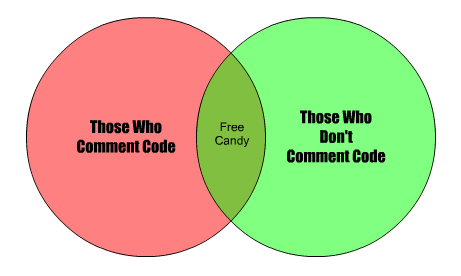
I was recently asked why I don’t comment my code. It’s a fair enough question. There was a time when commenting your code was the done thing. I was once a great believer in commenting code as much as possible and would bash those that didn’t, but now I vary rarely comment my code at all. In my current project of over 1,500 LOC, there are only a handful of comments. Many people will argue this is irresponsible. Well how is anyone supposed to pick up and understand my code, if it’s not commented?

The code should comment itself.

That just sounds silly. It’s like saying a car should drive itself. But it can be done. A lot of this change of heart about comments has come from my commitment to becoming a better developer and spending countless hours reading about the practice of great development, which is something I’ve written about in the past. I’m a big believer that most of the time if you need to comment a piece of code, then it’s either bad code or too complicated. Of course that’s not true 100% of the time, but for the other 99% it really is. There are cases where things need to be explained and especially warned of, but a lot of the time, commenting is just an easy escape from having to do “proper” coding. It took me years and years to get a basic understanding of proper OO and I’ve still got a long way to go to reaching Journeyman levels of understanding, but I would always create large objects with huge and complex methods, when really what I needed were more concise classes with more responsibility for what they should be able to do. It’s not object orientated when you’re focus is on the method and not the class.

A simple example of commented code:

  # Feed the fish.
  def check_food(food)
     # Check if Fish has eaten more then 5 hours ago.
     if self.last_meal_time < 5.hours.ago
       return "Not hungry"
     # Check if the Fish eats this food.
     elsif !self.edible_foods.contains?(food)
       return "Can't eat that!"
     # Make sure the fish isn't being underfed.
     elsif food.amount <  fish_feeding_amount(self.type)
       return "Not enough food."
     # Make sure the fish isn't being over fed.
     elsif food.amount > fish_feeding_amount(self.type)
       return "Too much food."
     end
     # Eat food.
     self.eat(food)
  end

Most comments can be done away with. If we split out functionality into more concise bits, then just reading the code should explain what’s happening better:

  def feed(food)
    return "Not Hungry" if self.recently_eaten?
    return "Can't eat that!" if self.does_not_eat?(food)     
    return "Not Enough food" if self.not_enough_food?(food)
    return "Too much food" if !self.too_much_food?(food)
    self.eat(food)
  end

This isn’t a great example as once again the validation of whether the food can/will be eaten should move into it’s own method or class ever. If we’re follow Uncle Bob’s SOLID principles, the above examples breaks the OCP (Open Closed Principle) where entities should be open to extension and closed to modification. If more validation rules were needed, then that would require the code to be modified.